

Myopia Management
Helping Kids See Clearly Today — and Protecting Their Vision for Tomorrow
Nearsightedness in children isn't just about needing stronger glasses each year. At Primaris Vision, we offer evidence-based myopia management designed to slow the progression of myopia during childhood — supporting healthier eyes for life.

Why Managing Myopia Matters
Each step of myopia progression means more than a thicker lens. As the eye elongates, the structures inside it stretch — and higher levels of myopia are associated with an increased lifetime risk of certain eye conditions, including:
-
Retinal detachment
-
Myopic maculopathy
-
Glaucoma
-
Early cataract
Slowing myopia progression during childhood can meaningfully reduce a child's final prescription — and with it, their long-term risk profile. That's the goal of myopia management: not just clear vision now, but healthier eyes for decades to come.


Our Myopia Management Options
There's no single right approach for every child. Dr. Yu will recommend a strategy based on your child's age, prescription, rate of progression, lifestyle, and comfort level. Options may include:
Myopia Control Spectacle Lenses
Specially designed eyeglass lenses that provide clear vision while using peripheral optical zones to signal the eye to slow its growth. These look and feel like regular glasses — an excellent first option for younger children. We work with leading lens designs from our trusted lens partners.
Myopia Control Soft Contact Lenses
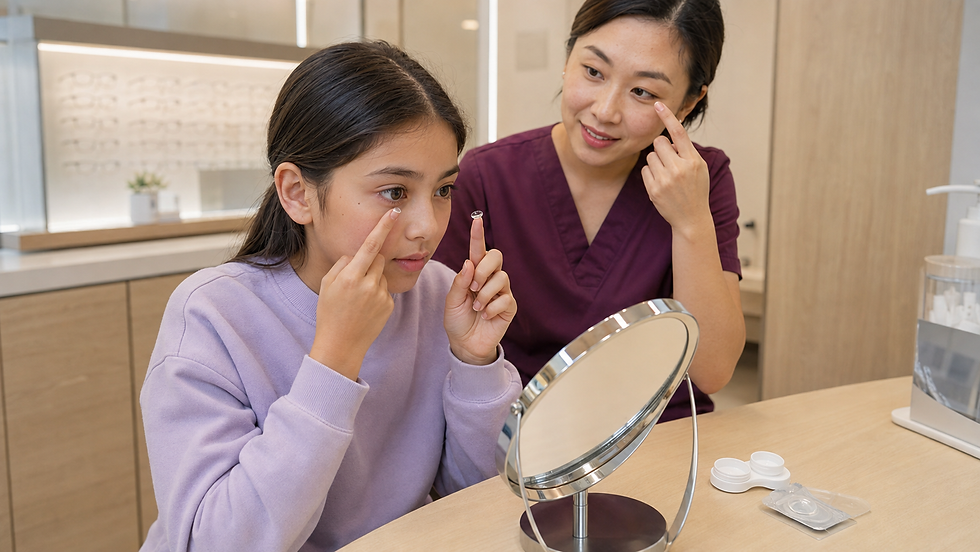
Daily disposable soft lenses designed specifically for myopia control in children. Clinical studies have shown these lenses can significantly slow myopia progression compared to standard correction. Daily disposables are also a hygienic, low-maintenance option well suited to kids and teens.
Orthokeratology (Ortho-K)
Custom-designed rigid lenses worn overnight that gently reshape the front surface of the eye, providing clear daytime vision without glasses or contacts — while also slowing myopia progression. A popular choice for active kids and swimmers. As a clinic experienced in specialty RGP and scleral lens fitting, we're well equipped for ortho-k candidacy assessment and fitting.
Low-Dose Atropine Therapy
A diluted eye drop used nightly that has been shown to slow myopia progression in children. Atropine may be used on its own or in combination with optical treatments, depending on your child's needs.

Healthy Habits That Help
Alongside clinical treatment, everyday habits can support your child's eye health:
-
More time outdoors. Research suggests that two hours of daylight per day is associated with a reduced risk of myopia onset in children.
-
The 20-20-20 rule. During reading or screen time, encourage a break every 20 minutes: look at something 20 feet away for 20 seconds.
-
Healthy working distance. Encourage holding books and devices at least 30 cm from the eyes, with good lighting.
These habits work best alongside — not instead of — a myopia management plan.
Frequently asked questions

What is Myopia?
Myopia — commonly called nearsightedness — occurs when the eye grows slightly too long, causing distant objects to appear blurry while near objects stay clear. It typically appears in school-aged children and tends to progress year over year as the eye continues to grow.
Myopia is becoming more common with every generation. Increased time on near work and screens, and less time outdoors, are believed to play a role. Many children today develop myopia earlier and progress faster than their parents did.
The important thing to understand: myopia is progressive, but progression can often be slowed. The earlier we intervene, the more we can influence the outcome.